Over the last 30 days, eleven Otter Property Management clients have told me they intend to sell one or more rental properties.
More are exploring it.
I get it. From 2021 through 2025, Philadelphia landlords endured an unusually difficult operating cycle. Expenses rose, leasing became more competitive, and rental income often failed to keep pace.
But I think many owners are leaving at exactly the wrong moment.
*I am not saying Philadelphia property prices are at the bottom. I cannot tell you what price your Realtor may get, particularly if a vacant rowhouse can be sold to a homeowner.
I am talking about the bottom of the operating cycle.
And I am making a prediction:
Philadelphia rents are going to increase in 2026, 2027, and 2028 in ways they did not in 2023, 2024, and 2025.
I am already feeling the change in 2026. There is more appetite for higher asking rents. Renewal increases are becoming easier to support. Tenants remain price-conscious, but they do not seem to have the same abundance of competing choices they had over the last several years.
The data is beginning to show the same thing.
Philadelphia single-family rents increased 4.7% year over year in March 2026, compared with only 1.3% nationally. That was the second-highest increase among the ten largest metropolitan markets tracked by Cotality’s Single-Family Rent Index.
That measurement is particularly relevant to Philadelphia landlords because it includes houses, rowhomes, condominiums, and smaller rental properties that make up so much of our market.
The supply pendulum has turned
In 2021, Philadelphia authorized 25,257 housing units as developers rushed to qualify projects before changes to the city’s tax abatement.
In each of the next four years, the city authorized only about 3,000 to 4,000 units:
3,223 in 2022
3,863 in 2023
2,962 in 2024
3,366 in 2025
The full series is available through the Federal Reserve Bank of St. Louis using U.S. Census Bureau permit data.
^look at this chart. and you'll understand why there has been an abundance of rental inventory in Philly in recent years suppressing rents.
That extraordinary 2021 spike produced much of the inventory delivered during 2023, 2024, and 2025. But that wave is receding.
Philadelphia recorded only 1,502 market-rate apartment starts in 2025, down from nearly 7,000 three years earlier and the city’s lowest total since 2013. Deliveries had already fallen 37% from their 2024 peak, according to Yardi data reported by Bisnow.
The apartments that will compete with landlords in 2027 generally need to be under construction now.
Most of them are not.
Why I expect rents to increase
Rent is ultimately determined by where supply and demand meet.
For purposes of this argument, I am not assuming a dramatic change on the demand side. I am not projecting a sudden population boom, extraordinary net migration, or a major surge in household formation.
I am making a simpler argument about supply.
Philadelphia has already absorbed the high-water mark of the recent construction cycle. The extraordinary volume of new inventory that entered the market during 2023, 2024, and 2025 is declining, and the pipeline behind it is much smaller.
At the same time, units continue to disappear from the bottom of Philadelphia’s rental market.
Older affordable units are lost through deterioration, abandonment, fire, demolition, conversion to owner occupancy, substantial renovation, or rent increases that move them out of the affordable category. Some remain physically present but are no longer functional, licensed, or economically viable as low-cost rentals.
New construction and office conversions will add units, but they are not replacing that lost inventory at the same price points. A newly constructed studio renting for more than $2,000 is not a substitute for an older two- or three-bedroom rowhouse serving a working family.
That means Philadelphia can add new apartments while still losing the inventory that matters most to ordinary renters.
The supply curve has already reached its recent high-water mark and is now moving back. New construction starts are down. Deliveries are declining. Affordable units continue falling out of the bottom of the market.
If demand remains even reasonably stable, rents have to adjust.
That is why I expect 2026, 2027, and 2028 to tell a different rent story than 2023, 2024, and 2025.
Owners are looking backward
Many landlords are selling because the last several years exhausted them.
They remember the vacancy that took too long to fill. The rent reduction. The expensive turnover. The roof, sewer line, insurance renewal, water bill, and legal costs.
They are looking backward at the worst operating years of the cycle.
The potential buyer is looking forward.
The buyer sees Philadelphia single-family rents already rising 4.7%. The buyer sees construction starts at their lowest level since 2013. The buyer sees a much smaller supply pipeline for 2027 and 2028.
Not every owner should hold. Selling may still make sense if a property needs major capital work, has chronic tenant or licensing problems, carries dangerous debt, or can receive a substantial owner-occupant premium.
But owners of fundamentally sound rentals should recognize where we are in the cycle.
They have already endured most of the pain.
Now, just as the supply-and-demand equation begins moving back in their favor, many are preparing to leave.
Philadelphia rents are going to increase in 2026, 2027, and 2028 in ways they did not in 2023, 2024, and 2025.
These owners may receive a perfectly respectable sale price.
Operationally, I still believe they are selling at the bottom.
They paid for the downturn.
The next owner will collect the recovery.
See more in my short data-packed video below
Philadelphia Rental Market Data

Rentals were really dragging through the winter, hitting a massive peak of 75 days on market back in January. Since then, the pace has picked up significantly, and we're back down to a much faster 43-day turnaround as the summer market stays hot.

The data shows Philly rents are on a steady climb, even with a temporary spike in inventory earlier this spring. Now that the number of available rentals is starting to dip again, it’s looking like landlords have plenty of room to keep pushing those prices up through the rest of the year.
Real Estate News & Events

Great headline for Mamdani and his base. Not great for the long term supply of safe & affordable housing in NYC. These policies always have heartwarming headlines and rent-warming long term implications.

Manayunk is about to get a massive face-lift with over 800 new homes coming to Venice Island, which is basically building a whole new neighborhood on just 30 acres. It’s a wild mix of townhouses and duplexes that’s going to completely change the vibe
Philly Investor Tips
PGW Is Requiring More From Landlords to Keep Lien Protection
If you are a Philadelphia landlord with individually metered gas service at your rental units, you should participate in PGW’s Landlord Cooperation Program.
The program can be extremely valuable. It helps protect a registered property from a lien caused by unpaid gas usage while the account is in the tenant’s name. Without that protection, a tenant’s unpaid balance can become a problem for the property owner.
But PGW is now requiring more, and requiring it faster, from landlords who want to keep those protections. New terms taking effect at the end of August create stricter compliance requirements and shorter response windows.
Your rental license must remain valid. PGW will not protect periods when the property does not have an active rental license. Even a temporary lapse could create exposure.
Response deadlines may shrink to three business days. Landlords previously had more time in many situations. PGW emails now need to be treated as urgent.
Miss a notice and the gas account may be placed in your name. If you do not respond or complete PGW’s required steps, the account may revert to the owner until the issue is resolved.
Failing to provide meter access can terminate your protection. This includes access for shutoffs, meter maintenance, leak surveys, and other PGW work.
The program does not cover theft or unauthorized usage. Meter tampering, illegal reconnections, and similar usage can still result in a lien.
The takeaway is simple: enroll every eligible property, keep your rental licenses current, and make sure someone is actively monitoring PGW notices.
Tenant Tales
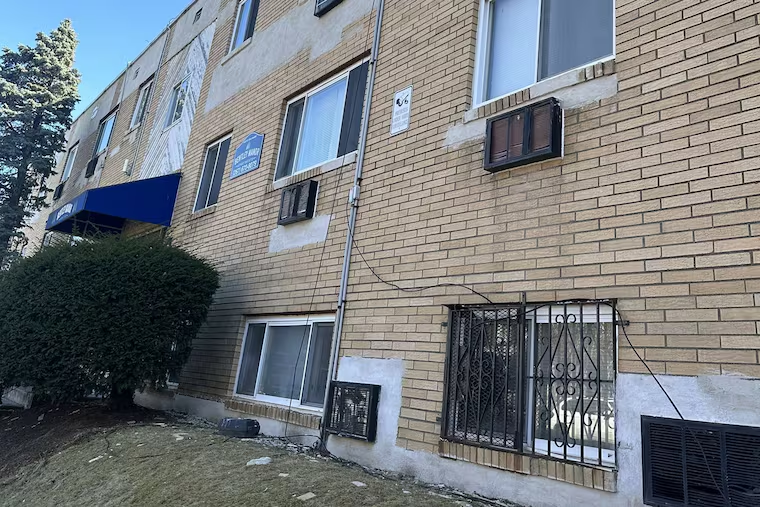
Wake up. Look at your phone. "ur apartment burned down.
cats ok?"
Imagine waking up at 10:40 a.m. to a text from your landlord telling you that your apartment burned down.
That recently happened to one of our tenants.
He was two days away from the end of his lease and in the process of moving out. He had removed most of his belongings and spent the night at his girlfriend’s place.
But the lease was still active. He had not surrendered possession, returned the keys, or informed us that the unit was vacant. From the property manager’s perspective, this was still an occupied apartment under the tenant’s control.
That morning, I had to call him personally.
First, I asked whether he and his cats were safe. He told me they were, then added, “Honestly, this is the first I’m hearing of anything. I’m at my girlfriend’s place.”
Not exactly the news anyone expects to wake up to.
The timing got worse. He had already removed nearly everything from the apartment, except for what he described as his “important documents.” His passport, birth certificate, and similar records were still inside.
Yikes.
According to the fire department, there was a suspicion that squatters realized the apartment was temporarily unattended during the move-out process, broke in, and started the fire.
To be clear, this was not a vacant unit that had been turned back over to management and left unsecured. The tenant still had an active lease and remained in possession. Management had no notice that he had effectively stopped staying there before the lease ended.
Fortunately, the tenant was safe. The cats were safe. Even the important documents were recovered without issue.
The property owner’s insurance carrier also stepped up quickly and is covering both the physical damage and the owner’s lost rental income. That is exactly why appropriate landlord insurance matters.
So, in the end, this was a bizarrely well-timed disaster. Two days before the lease ended, most of the tenant’s belongings were already gone, nobody was home when the fire started, and the owner had the right insurance coverage in place.
The property itself is another story.
I will return to this incident in a future issue because what happened after the fire says quite a bit about the practical risks of owning and operating rental housing in Philadelphia.
Closing Thoughts

New Housing Structures Philadelphia
|
PROUDLY SPONSORED BY
|